
Local Government Elections
Summary
Democracy cannot function without communication. If voters are to make informed choices among candidates, they must have the opportunity to learn about candidates’ policy positions. During the last two Tasmanian Local Government elections (2018 and 2022) PMAT endeavoured to survey all candidates to ask their position on key planning issues.
PMAT's Key Concerns
- No compulsory requirement for all Local Government election candidates to provide their contact details to the Tasmanian Electoral Commission. Obtaining candidate email addresses is difficult, time consuming and in many instances impossible within election timeframes. Democracy cannot function without communication. To make informed choices among candidates, voters must be able to learn about candidates’ policy positions.
- Tasmania is the only state in Australia with no political election campaign donation disclosure requirements for all local council candidates. New candidates have no requirements to disclose election campaign donations, while sitting councillors are currently required to disclose (specified amounts of) donations and gifts during both electoral and non-electoral periods. This means new candidates who are currently not sitting on council will not have to disclose their political donations creating an unfair playing field.
- As at August 2021, most Tasmanian councils were in breach of rules for disclosure of gifts and donations, which raises questions about the lack of effective oversight by the State Government.
PMAT's Key Recommendations
- All election candidates must provide their contact details, including their email address, to the Tasmanian Electoral Commission.
- All Local Government election candidates’ contact details, including their email address, must be made publicly available, in a timely and easily accessible format e.g. by both spreadsheet and PDF.
- Improve the administration of the General Manager’s Roll (i.e. ratepayers who live outside the council area). The Tasmanian Electoral Commission should reverse their 2022 decision to not provide postal addresses of eligible voters enrolled on each Council’s General Manager’s Roll. This decision, which was not communicated to candidates, excludes many ratepayers from receiving candidate election materials.
- Local councils should retain their role as a Planning Authority. The overwhelming majority of local council candidates who took part in PMAT’s 2022 Local Government Election planning survey believe local councils should retain their role as a Planning Authority. That is, councils should retain the power to vote on the developments that have the greatest impact on their local community. They do not want to give up this right to represent their local communities.
- Councils should have greater capacity to protect local character and amenity and places important to local communities. The overwhelming majority of local council candidates who took part in PMAT’s Local Government Election 2018 planning survey believe local councils should have greater capacity to protect local character and amenity and places important to local communities. They believe major tourist developments in National Parks should be released for public comment, and that local councils should have the final approval (with opportunity for merit-based planning appeals). There was also overwhelming support for planning rules to protect people’s right to privacy in their own home.
Background
Every four years, residents, and ratepayers in each of Tasmania’s 29 council areas elect councillors to represent them. Each council has between 7 and 12 councillors, including a mayor and deputy mayor.
The next Local Government elections will be held in September 2026.
Local government elections are held by full postal ballot. This means voters do not attend a polling place to vote, as they do for State and Federal elections. Instead, information required to vote is sent directly to each voter’s address.
Until 2022, voting in Local Government elections in Tasmania was voluntary.
In June 2022, with no forewarning, the Tasmanian Government introduced compulsory voting at local government elections for the first time through the Local Government Amendment (Elections) Act 2022.
According to the State Government a key objective of compulsory voting was to ‘‘increase voter participation and strengthen connections between communities and their local councils.’
The 2022 Local Government elections saw a statewide turnout of 84.79%. These results represent a significant increase in voter participation from 58.7% in the 2018 elections.
PMAT’s Local Government candidate surveys
Democracy cannot function without communication. If voters are to make informed choices among candidates, they must have the opportunity to learn about candidates’ policy positions.
During the last two Tasmanian Local Government elections (2018 and 2022) PMAT endeavoured to survey all candidates to ask their position on key planning issues.

Authorised by PMAT Public Officer, Eric Pinkard 7 Ogilvie Street, Mt Stuart Tas 7000
2026 Local Government Elections
Local Government elections are underway across lutruwita/Tasmania, with polls closing on 27 October.
To help you make an informed choice, PMAT surveyed candidates across key planning issues and democracy. There are 441 candidates nominated across all 29 councils. We were able to obtain 384 emails for candidates, with 99 responses across 27 councils.
Thank you to every candidate who took the time to complete our survey. Here are the results:
AI data centres: strong support for proper assessment
- 92% of candidates support AI data centres being assessed as a Level 2 activity, with a formal integrated environmental impact assessment by both the Environmental Protection Authority (EPA) and local councils.
- 92% of candidates support guaranteed planning appeal rights for AI data centres.
Development Assessment Panels: near-unanimous opposition
- 96% of candidates do not support the proposed Development Assessment Panel (DAPs) legislation. Only 3 candidates said yes.
Elector petition thresholds: most want to keep them
- 81% of candidates support keeping elector petition thresholds for public meetings and elector polls at 5% or 1000 electors, whichever is the lesser.
Smaller councils: candidates say no
- We asked candidates in the smaller councils whether they support reducing their council to five members. Every candidate we heard from in West Coast, Flinders Island, King Island and Tasman said no.
Not every candidate responded, and some council areas had no replies at all (Kentish, and Circular Head).
Download the full survey questions and see how every candidate answered, by council area below.
2022 Local Government Elections
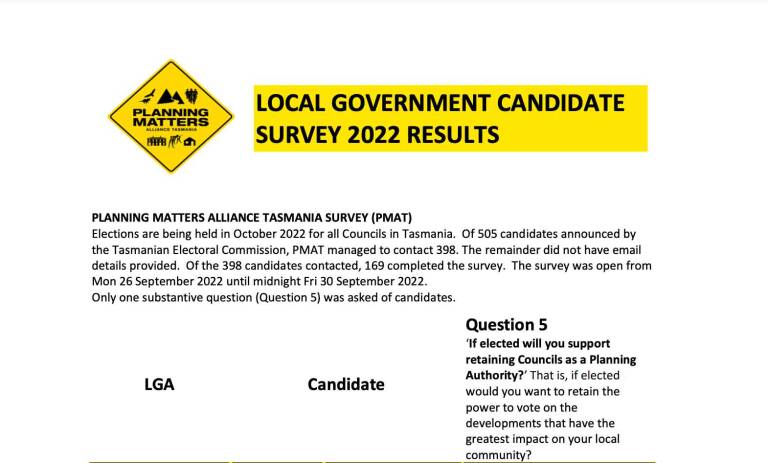
In 2022, PMAT surveyed 398 of the 505 local council candidates. Of the 398 candidates, 169 completed our survey.
PMAT’s survey asked one critical question of candidates: ‘If elected, will you support retaining Councils as a Planning Authority? That is, if elected would you want to retain the power to vote on the developments that have the greatest impact on your local community? Would you want to give up this right to represent your local community?’
The overwhelming majority (99.4%) of local council candidates who took part in PMAT’s planning survey believe local councils should retain their role as a Planning Authority. That is, local councils should retain the power to vote on the developments that have the greatest impact on their local community. They do not want to give up this right to represent their local communities.
2018 Local Government Elections
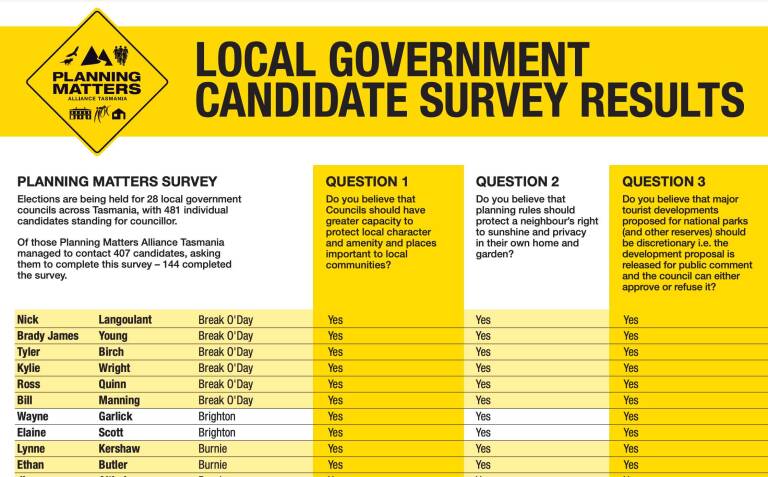
In 2018, PMAT surveyed 407 of the 418 local council candidates. Of the 407 candidates, 144 completed the survey.
The overwhelming majority of local council candidates who took part in PMAT’s planning survey believe local councils should have greater capacity to protect local character and amenity and places important to local communities. They believe major tourist developments in national parks should be released for public comment, and that local councils should have the final approval. There was also overwhelming support for planning rules to protect people’s right to privacy in their own home.
PMAT’s 2022 Local Government Elections Feedback
Following the 2022 Local Government elections, the State Government undertook a public consultation process in December 2022 to hear about people’s experiences and perspectives on what worked well and what could be improved for future local government elections.
According to the State Government, the information from this process will form part of the formal review of local government electoral arrangements currently being undertaken by the Office of Local Government.
See PMAT’s submission on the 2022 Local Government elections here and under the News and Resources website section below.
Tasmania is the only state in Australia with no political campaign donation disclosure requirements for all local council candidates
There are no political election campaign donation disclosure requirements covering all local council candidates. Sitting councillors are currently required to disclose (specified amounts of) donations and gifts during both electoral and non-electoral periods.
However, new candidates who are currently not sitting on council do not have to disclose their political election campaign donations, creating an unfair playing field. According to the Tasmanian Inquirer, Tasmania is the only state in Australia with no political campaign donation disclosure requirements for all local council candidates.
Click here Explainer: Tasmania’s new laws for council candidates to disclose their donations, Tasmanian Inquirer, June 2021.
This article also outlines the best elements of existing donations disclosure regimes in Australia for local government candidates. Also according to the Tasmanian Inquirer, as at August 2021, most Tasmanian councils were in breach of rules for disclosure of gifts and donations, which raises questions about the lack of effective oversight by the State Government.
Submissions & Guides
2026 MAY: Local Government Amendment (Targeted Reform) Bill 2026
Please see below PMAT’s guide to help the Tasmanian community email the Legislative Council on the Local Government Amendment (Targeted Reform) Bill 2026 before it went to vote on 25 June 2026.
2026 FEB: Local Government Electoral Reform
Please see below PMAT’s submission regarding on the Local Government Electoral Legislation: Local Government Electoral Bill 2025 and Local Government Amendment (Electoral Reforms) Bill 2025.
Two draft bills were released for public consultation for a for a 13-week consultation period until Saturday 28 February 2026:
1. A new, standalone Local Government Electoral Bill 2025 for future council elections
2. A Local Government Amendment (Electoral Reforms) Bill 2025, delivering a number of reforms to the Local Government Act 1993 supporting the broader elections framework
2023 JAN: Local Government Elections Feedback
Please see below PMAT’s submission to provide feedback on the 2022 Local Government elections
PMAT’s main feedback is that all Local Government candidate contact details must be publicly and easily available in a timely fashion. This recommendation has been informed by our previous work. During the last two Tasmanian Local Government elections PMAT endeavoured to survey all candidates, via email, to ask their position on key planning issues. Obtaining candidate email addresses was difficult, time consuming and took many volunteer hours and in many instances was impossible within the election timeframes.
News & Resources
- Tasmanian Electoral Commission – click here for information about the Local Government elections run by the Commission.
- The Department of Premier and Cabinet – click here for information about the Office of Local Government and Local Government elections.
- 2022 Local Government Elections Feedback – click here for PMAT’s submission.
- PMAT The Mercury Talking Point: Vital to Keep Planning Matters Local, September 2022, click here.
- In 2022, a PMAT member group, Friends of Rosny Hill, called for candidates they can back in the local council elections, click here.
PMAT Local Government Candidate Surveys
Related News & Media

PMAT Submission: Local Government Elections Feedback
PMAT’s main feedback is that all Local Government candidate contact details must be publicly and

Local Government Candidate Survey Results 2022
In 2022, PMAT surveyed 398 of the 505 Local Government candidates. Of the 398 candidates,

Talking Point: Vital to Keep Planning Matters Local
“We want councils to continue their vital role as ‘place shapers’ underpinning community wellbeing and

PMAT Media Release: Comprehensive Survey of Council Election Candidates Reveals Strong Support for Local Planning Controls
In what is likely to be the biggest survey of candidates in the upcoming local

Support Us
Receive News & Updates from PMAT
Stay informed on what’s happening locally and statewide within Tasmania, and join our community in advocating to protect Tasmania’s future.