
State Elections
Summary
Democracy cannot function without communication. If voters are to make informed choices among candidates, they must have the opportunity to learn about candidates’ policy positions. During the last three State Elections PMAT surveyed candidates to ask their position on planning.
PMAT's Key Concerns
- No compulsory requirement for all State Election candidates to provide their contact details to the Tasmanian Electoral Commission. Obtaining candidate email addresses by the community is difficult, time consuming and in many instances impossible within election timeframes. Democracy cannot function without communication. To make informed choices among candidates, voters must be able to contact candidates to learn about their policy positions.
- Political donations are unregulated in Tasmania, undermining democracy. Property developers and their associates for example, can donate to political parties and candidates unlike in NSW, QLD and ACT.
PMAT's Key Recommendations
- All election candidates must provide their contact details (at minimum their email address), to the Tasmanian Electoral Commission. To make informed choices among candidates, voters must be able to contact candidates to learn about their policy positions.
- All State Election candidates’ contact details (at minimum their email addresses), must be made publicly available by the Tasmanian Electoral Commission, in a timely and easily accessible format e.g. by both spreadsheet and PDF.
- Reform electoral funding ensuring integrity, transparency and accountability. Prohibit property developers and their associates from making political donations to political parties and candidates, as in NSW, ACT and QLD. Ensure there are no loopholes such as donating through charitable structures. Banning property developer donations to political parties and candidates will reduce the risk of corruption.
State Election Surveys
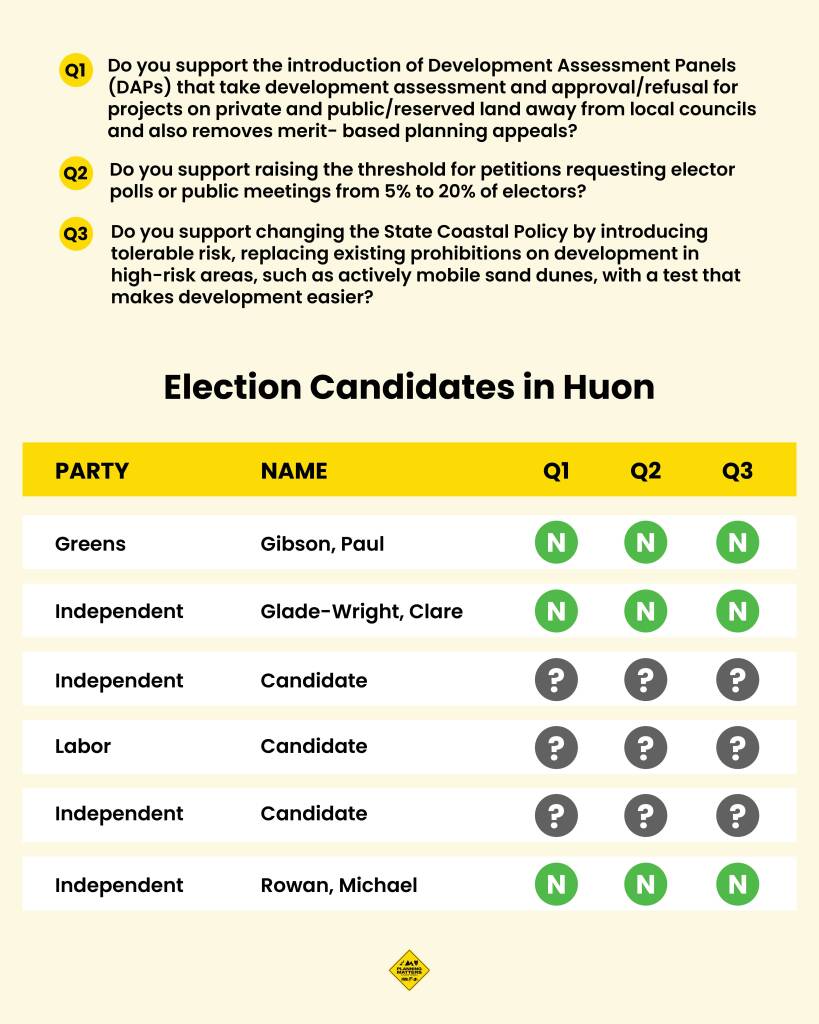
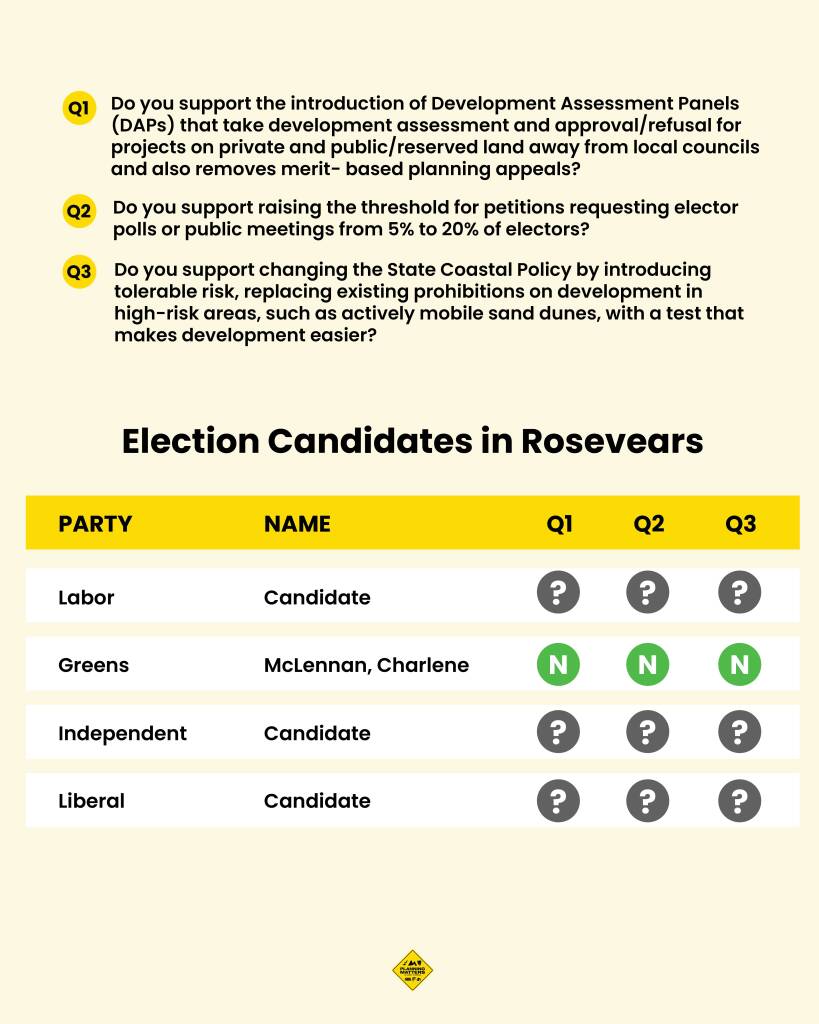
2026 Legislative Council Election Candidates Survey - Huon & Rosevears
A Tasmanian Legislative Council (Upper House) Election is being held 02 May 2026 for the seats of Huon and Roseveares. Polling day is on 02 May 2026. Early voting and postal voting commenced 13 April 2026.
As part of our election work, PMAT surveyed candidates on key planning issues. lutruwita/Tasmania’s planning system, democracy and good governance are under pressure, with the State Government pushing changes that could strip local councils of their development assessment and approval powers, make it harder for residents to call for elector polls and public meetings, and weaken protections for Tasmania’s coastlines. It’s important to know where candidates stand on these critical issues.
Of the 10 candidates announced by the Tasmanian Electoral Commission, only 4 completed the survey. No candidates from the Labor or National parties responded to the survey.
The survey was open from Saturday 18 April 2026 until Friday 24 April 2026.


2025 State Election Candidates Survey
A State election is being held on 19 July 2025 for all House of Assembly seats.
As part of our election work, PMAT surveyed candidates on key planning issues — because land use and development decisions shape the future of our homes, neighbourhoods, environment, and economy.
Of the 161 candidates announced by the Tasmanian Electoral Commission, PMAT was able to obtain contact details for 120 candidates. Several emails unfortunately bounced, and where contact details were missing, we reached out to party/group contacts with a request to forward the survey link.
No candidates from the Labor or National parties responded to the survey. After the survey had closed, the Liberal Party submitted a letter outlining general positions on each of the five questions on behalf of all its candidates. However, the responses were not in a format compatible with the survey and did not provide definitive answers. As such, no late submissions have been included.
The survey ran from Monday 30 June to midnight Saturday 6 July, with reminder emails sent to non-respondents on 4 July.

2025 Legislative Council Election Candidates Survey on DAPs
Legislative Council (Upper House of Tasmanian Parliament) elections were held on 24 May 2025 in the seats of Montgomery, Nelson and Pembroke. All 13 candidates across the three seats were contacted by PMAT with an email inviting them to undertake a survey on their position on DAPs (Development Assessment Panels).
Of these, 7 candidates completed the survey. Three substantive questions were asked of candidates. The survey was open from Sunday 04 May 2025 until Tuesday 13 May 2025.
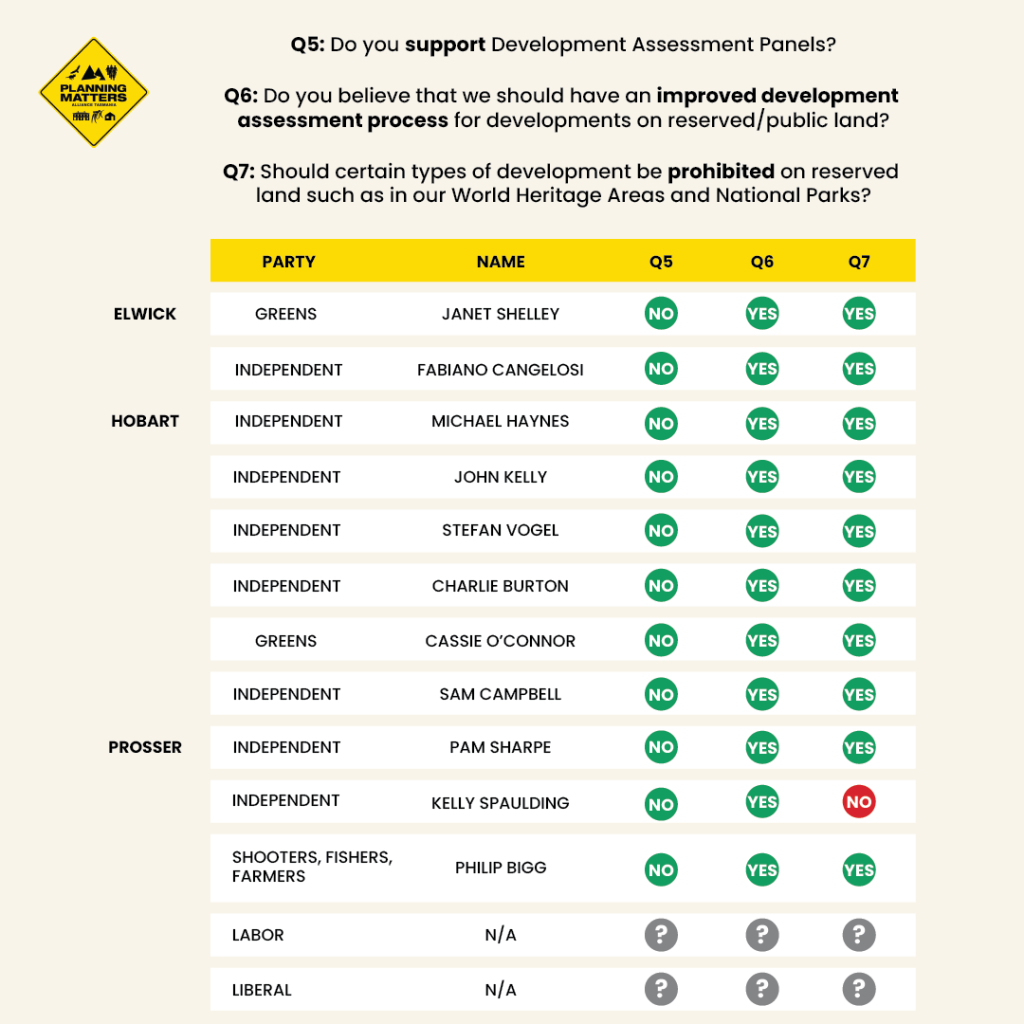
2024 Legislative Council Election Candidates Survey on DAPs
Legislative Council elections were held on 4 May 2024 in the seats of Elwick, Hobart and Prosser. All 16 candidates across the three seats were contacted by PMAT with an email inviting them to undertake a survey on their position on DAPs (Development Assessment Panels).
Of these, 11 candidates completed the survey. The survey was open from Sunday 14 April 2024 until midnight Saturday 20 April 2024.
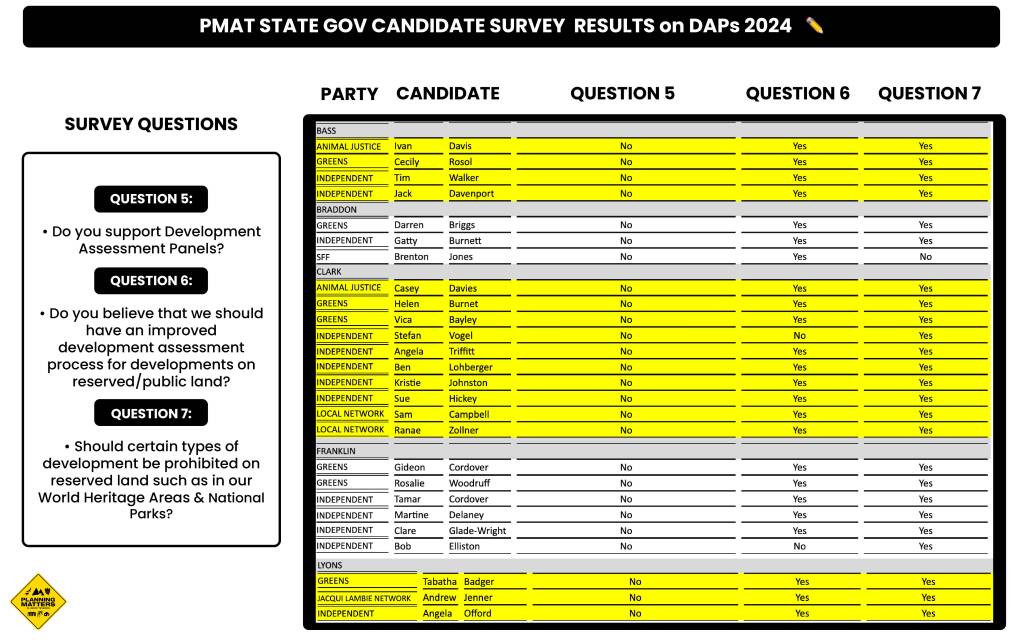
2024 State Election Candidate Survey on DAPs
A State election was held on 23 March 2024 for all House of Assembly seats. Of the 167 candidates announced by the Tasmanian Electoral Commission, PMAT managed to obtain email contact details for 160. The remainder did not have email details provided. Only 25 candidates completed the survey. The survey was open from Sunday 3 March 2024 until midnight Saturday 9 March 2024.


2021 State Election - 'Defend Tasmanian's Right to Have a Say'
In the May 1 2021 State Election, PMAT sought a commitment from all candidates, via our ground breaking Do Gooder online campaign ‘Defend Tasmanian’s right to have a say’, for stronger planning rules and regulations which better reflect community expectations and protect our Tasmanian brand. Our Do Gooder email campaign focused on three key areas:
- The potential of removing planning from local Councils. Creating a new fast track process to implement the Tasmanian Planning Scheme putting the places that you love at risk.
- Precluding the ability for third parties to appeal developments by making appeals prohibitively expensive
- In total, 348 people emailed their candidates to confirm the position of candidates regarding PMAT’s three key election issues.
2018 State Election
TV Ad and Crowd Fund Video – Residential Standards – Your Back Yard
PMAT’s TV ad and crowdfund video highlights failings of the residential standards of the Tasmanian Planning Scheme: Do you hold dear your home’s privacy, sunshine and neighbourhood character? Your voice, sunshine and privacy are at stake under new planning laws.
In urban areas smaller block sizes, higher buildings built closer to fences, and multi-unit developments in all residential areas are allowed. Neighbourhood amenity and character, privacy and sunlight into your backyard and garden, home and on your solar panels are not adequately protected. Rights to challenge inappropriate developments are very limited. The General Residential standards allow 100% concrete and roof with reduced setbacks and no guarantee of public comment. This also impacts biodiversity and creates a flood risk and heat island effects.
Under the Liberals’ new planning laws, you could have no say over commercial developments in your favourite national park or skycrapers in town.
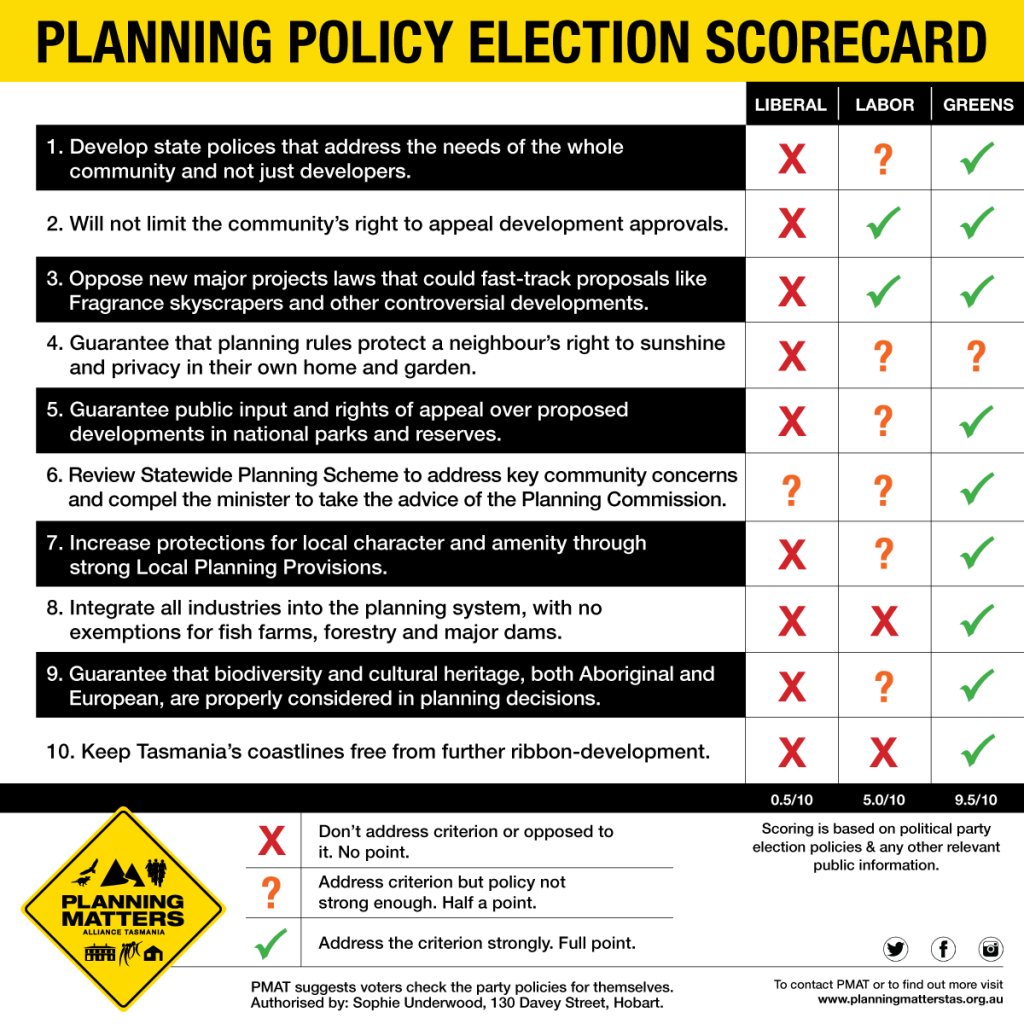
2018 State Election Policy Scorecard
The launch comes as PMAT commences its second election television advertisement. The advertisement links private commercial development in reserves and high rise hotel proposals with the simple fact that the public could have absolutely no role in the assessment of these proposals, or rights of appeal.
PMAT scored the three main political party’s planning policies against ten criteria that reflect the alliance’s priorities for making the planning system stronger. Overall the Greens were strongest on planning policies, scoring 9.5 out of 10, Labor got a pass with 5 out of 10, and the Liberals had an abject failure score of just 0.5 out of 10.

Support Us
Receive News & Updates from PMAT
Stay informed on what’s happening locally and statewide within Tasmania, and join our community in advocating to protect Tasmania’s future.