
Lutruwita/Tasmania is one of the most extraordinary places on Earth. Its wild landscapes, rich cultural heritage, and tight-knit communities are worth fighting for — and that’s exactly what Planning Matters Alliance Tasmania (PMAT) does.
PMAT’s activities are guided by the Resource Management and Planning System (RMPS), the framework that governs land use planning and development in Tasmania. PMAT works to ensure the RMPS delivers its objectives of maintaining healthy ecosystems through sustainable use and development of air, land and water, and encouraging community input in planning matters and decisions.
We are lutruwita/Tasmania’s only organisation solely focused on advocating for better planning — writing submissions, producing free community guides, holding public information sessions, and engaging with politicians and media on everything from National Parks and housing to Aboriginal heritage and climate change.
Governed by a volunteer skills-based Board and a growing network of almost 80 community groups, PMAT is proudly independent, community-driven, and funded entirely by donations.
Our Vision
PMAT’s vision is for Lutruwita/Tasmania to be a leader in planning excellence, supporting our communities and protecting nature, cultural heritage and democracy. We believe best practice planning must:
- Enhance the wellbeing, health and prosperity of all Tasmanians
- Protect and care for Tasmania’s outstanding natural environment
- Protect Lutruwita/Tasmania’s Aboriginal heritage, including cultural landscapes
- Enhance the liveability of cities, towns and rural areas
- Recognise and enrich our built and historic heritage
- Promote democratic and transparent processes to deliver sustainable, integrated development in harmony with the surrounding environment
Our Principle Purpose
Planning Matters Alliance Tasmania Inc. (PMAT) was established with the principal purpose of educating and communicating information on land use planning in Lutruwita/Tasmania. Land use planning plays a vital role in protecting and enhancing Tasmania’s natural environment and supporting ecologically sustainable development.
Platform Principles
PMAT believes that to achieve the best future for Tasmania and all Tasmanians, the planning system must also be underpinned by the following key principles. For full explanatory notes, download our platform document.
- Community & Environment
Prioritise the health, wellbeing and connectivity of the whole community, the liveability of cities, towns and rural areas, and the protection of the natural environment and built and cultural heritage. - Strategic Vision
Establish and promote a community endorsed, sustainable, long-term strategic vision for Tasmania. - Transparency & Independence
Ensure that planning and decision-making processes are open and transparent, and overseen by an independent commission, with appeals heard by an independent tribunal. - Community Involvement
Provide opportunities for informed community input in planning matters and decisions, including provision of appeal rights. - Integrated Approach
Provide an integrated assessment process across all types of developments on all land tenures which includes consistent provision of mediation, public comment. and appeal rights - Implementation
Consistent with the above principles, planning to be shared between state and local government, with local government to retain primary responsibility for local planning and development decisions, through community consultation.
Founded in 2016
PMAT was formed in 2016 and incorporated in 2018, with a growing network of almost 80 diverse community groups from across Tasmania. PMAT is Lutruwita/Tasmania’s only independent organisation dedicated solely to advocating for a land use planning system that ensures civic participation and protects our natural environment, cultural heritage and democracy for people, nature and future generations.
Watch highlights from our launch night featuring speakers Essie Davis, Meg Webb and Gerard Castles.
Founding Key Concerns
PMAT was founded in 2016 in response to serious and growing concerns about the direction of Tasmania’s planning system. Nearly a decade on, most of these founding concerns remain unaddressed.
The Tasmanian Government continues to push to centralise planning power away from local councils and communities, fast-track developments on public and private land, and weaken protections for our natural environment, coastlines, national parks and heritage. The current Tasmanian Planning Scheme also fails to adequately address climate change, community health and wellbeing, biodiversity, Aboriginal cultural heritage and affordable housing.
PMAT is actively working across all of these issues.
Democracy & Good Governance
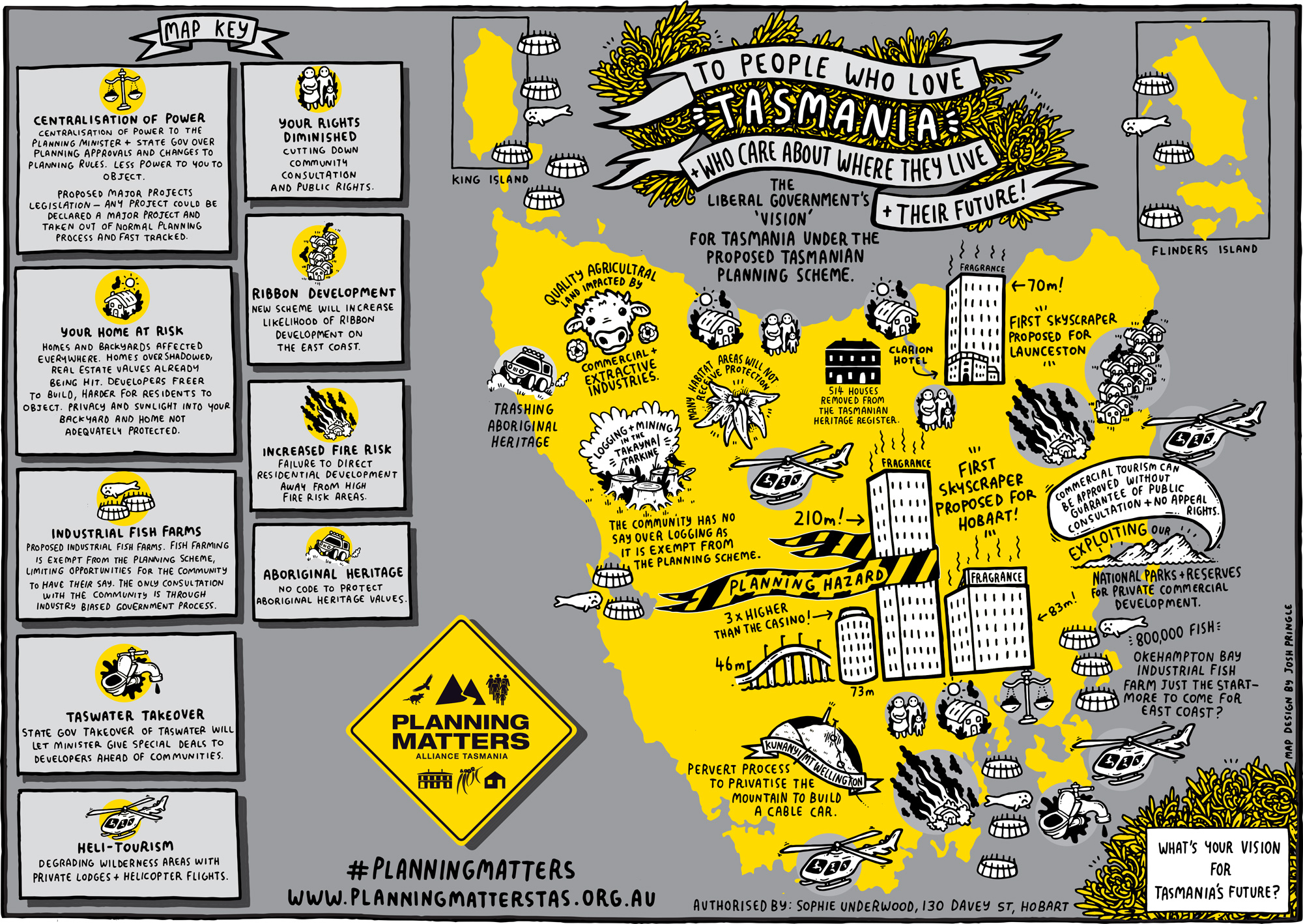
- Changes to development assessment and removal of appeal rights: the Tasmanian Liberal Government wants to remove development assessment from the normal local council process to be replaced by State-appointed Development Assessment Panels (DAPs) conducted by the Tasmanian Planning Commission. This will also remove the opportunity for planning appeal rights.
- Changes to how land is re-zoned: top-down land use rulings – the Tasmanian Liberal Government wants to increase Ministerial power to overrule local councils and force them to commence planning scheme changes.
- Local government reform including the potential for forced local council amalgamations.
- The community’s right to have a say: increasingly, land uses and development can occur without public consultation or rights of appeal, weakening democracy.
- Ministerial powers: power over planning decisions will shift into the hands of the Minister for Planning and away from the Tasmanian Planning Commission, councils and the public.
Environment & Cultural Heritage
- National Parks & Reserves: commercial tourism development can be approved in most national parks and reserves without guarantee of public consultation, and with no rights to appeal. This means the public has no guarantee of public comment and no appeal rights over public land on almost 50% of the State.
- Aboriginal Cultural Heritage: no provision for impacts on Aboriginal Heritage to be considered in a development assessment.
- Biodiversity issues: exemptions in the Natural Assets Code (i.e. Agriculture, Commercial and Residential Zones) and up-to-date mapping means many areas of native vegetation/habitat will not be assessed or protected, impacting biodiversity, including valuable urban trees.
- Coastal issues: weaker rules for subdivisions and multi-unit development will threaten our undeveloped beautiful coastlines.
- Heritage Buildings & Heritage Landscape: limited protections for heritage places will compromise Tasmania’s important cultural precincts and erode the heritage character of listed buildings.
- Lack of integration: forestry, mine exploration, fish farming and dam construction remain largely exempt.
Community & Housing
- Affordable and social housing: no provisions to encourage development of affordable or social housing.
- Urban issues: smaller block sizes, higher buildings built closer to fences, and multi-unit developments allowed in all residential areas. Inadequate protection for neighbourhood amenity and character, privacy, or sunlight into your backyard, home and on your solar panels. Rights to challenge or improve inappropriate developments are very limited.
- Climate change/energy: no opportunity to embed sustainable transport, green building design and emissions reductions considerations into the planning process.
- Community health and well-being: limited provisions to promote better health for all Tasmanians, including walking and cycling opportunities, local access to recreation areas and addressing food security.
- Gardens: residential standards do not encourage home gardens, important for food security, connection to nature, places for children to play, mental health/well-being and beauty.
- Rural issues: an unprecedented range of commercial and extractive uses will be permitted in Rural Zones, further degrading the countryside and Tasmania’s food bowl.
- Absence of key planning codes: including no Stormwater Code, On-site Waste Water Code or Geoconservation Code.
- Tasmania’s brand: our brand underpins our future economy. The Tasmanian Scheme should be an important tool for managing Tasmania’s brand, but it fails to protect the reasons why people live and visit here, including placing our natural and cultural heritage at risk.
Awards
PMAT’s advocacy has been recognised both nationally and locally. In 2019 we were named Tasmania’s Planning Champion by the Planning Institute of Australia, and in 2020 Australia’s Planning Champion — an honour recognising non-planners who have made a significant and lasting contribution to planning advocacy. In 2022 the Bob Brown Foundation named PMAT Community Group of the Year for our work ensuring development in Tasmania does not come at the cost of nature.

Governance
PMAT is a not-for-profit Incorporated Association under the Associations Incorporations Act 1964 (Tasmanian legislation).
PMAT is a not-for-profit Incorporated Association under the Associations Incorporations Act 1964. We are governed by a skills-based volunteer Board deeply committed to PMAT’s mission. Each year we hold an Annual General Meeting, open to all, providing the opportunity to review our performance, hear updates from Alliance members and ask questions of the Board.
Support Us
Stay informed. Protect what matters.
Sign up to receive planning alerts, campaign updates and opportunities to have your say on decisions that shape lutruwita/Tasmania’s. Because an informed community is a powerful one.