A Tasmanian Legislative Council (Upper House) Election is being held 02 May 2026 for the seats of Huon and Roseveares. Polling day is on 02 May 2026. Early voting and postal voting commenced 13 April 2026.
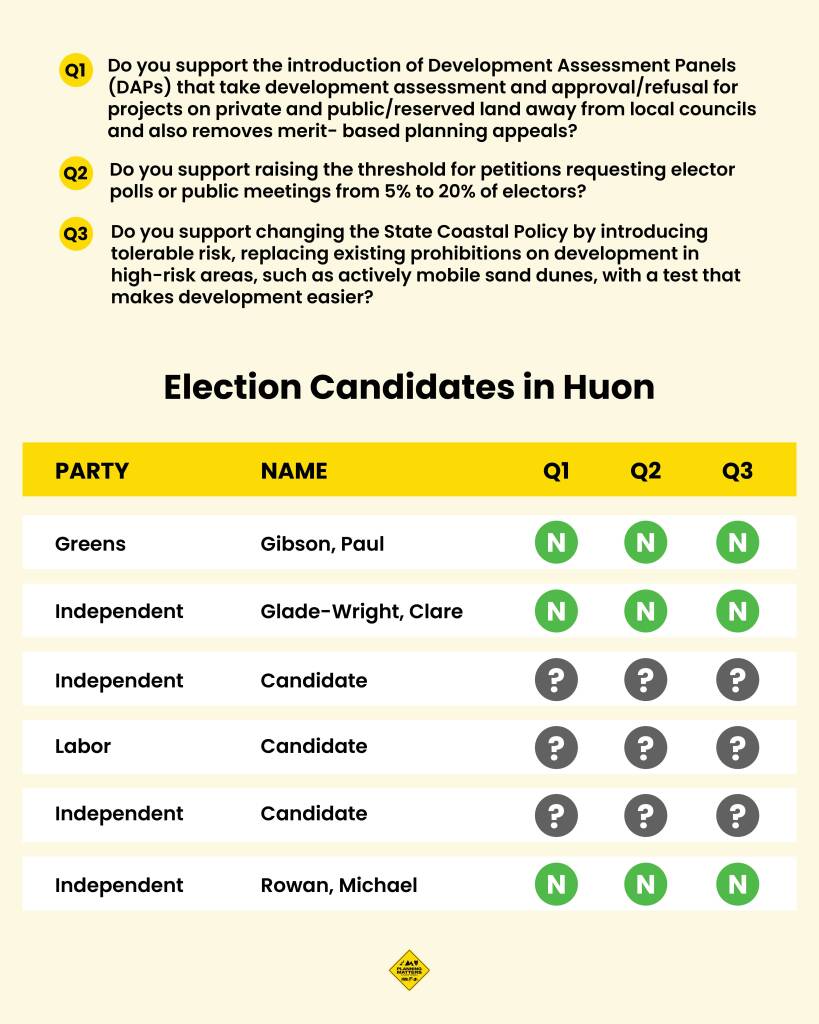
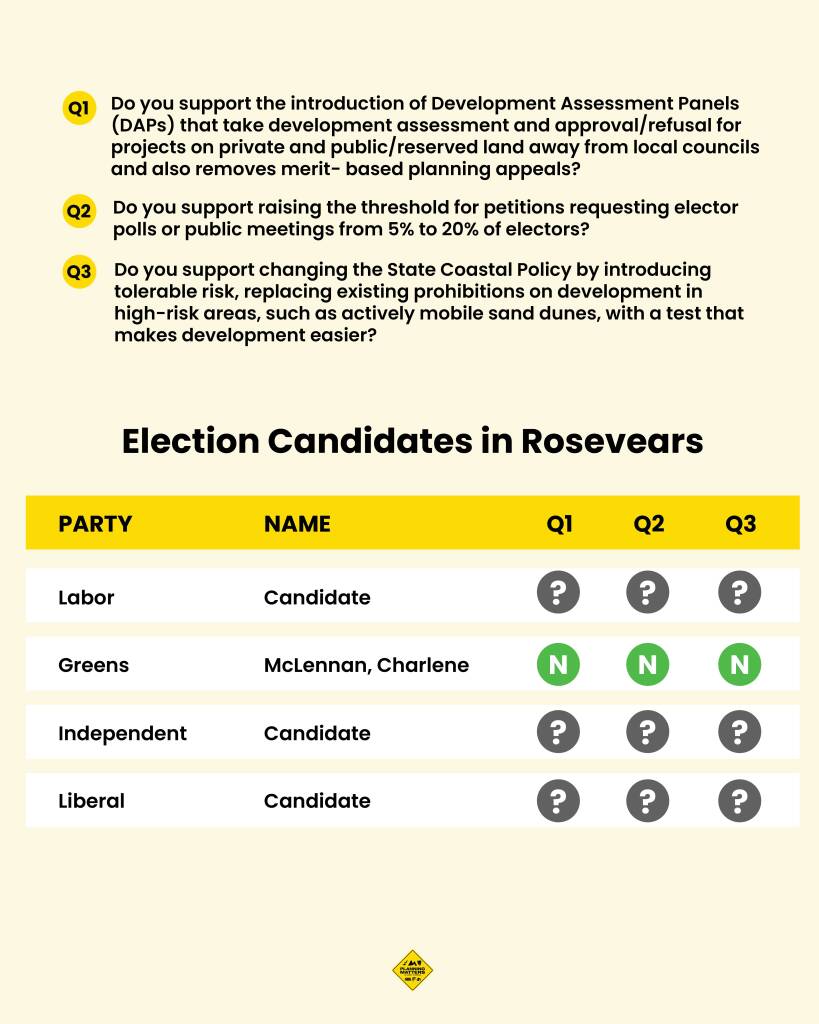
As part of our election work, PMAT surveyed candidates on key planning issues. lutruwita/Tasmania’s planning system, democracy and good governance are under pressure, with the State Government pushing changes that could strip local councils of their development assessment and approval powers, make it harder for residents to call for elector polls and public meetings, and weaken protections for Tasmania’s coastlines. It’s important to know where candidates stand on these critical issues.
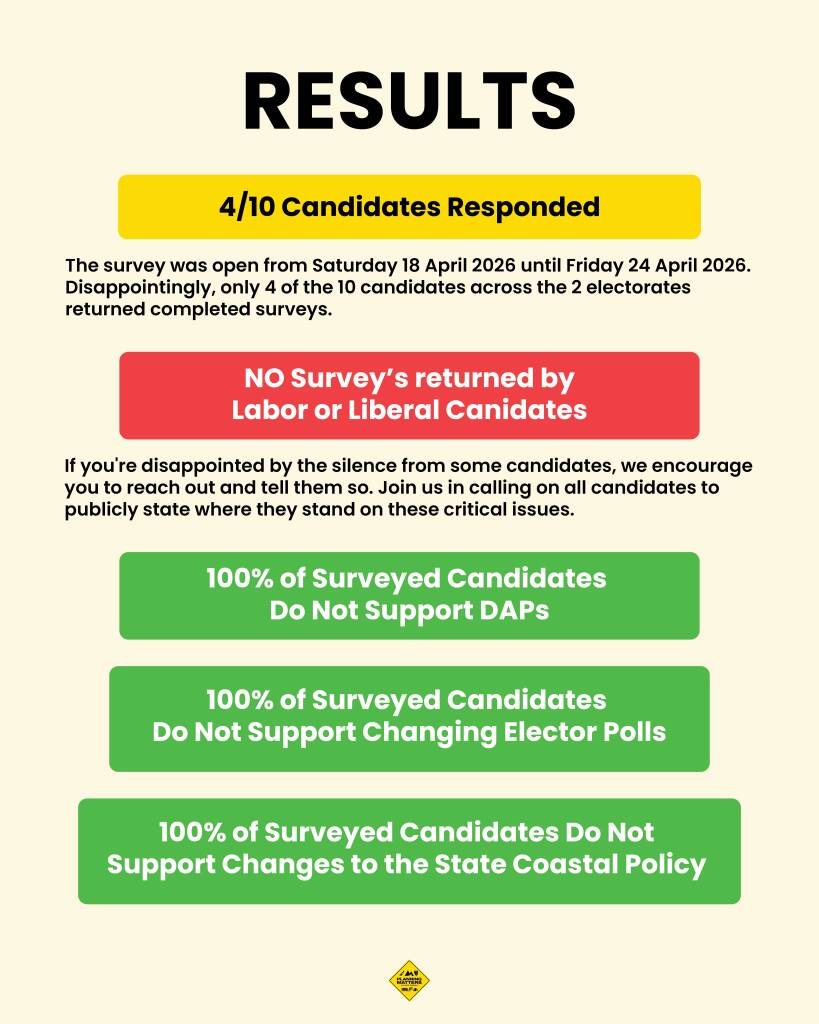
Of the 10 candidates announced by the Tasmanian Electoral Commission, disappointingly only 4 completed the survey. The survey was open from Saturday 18 April 2026 until Friday 24 April 2026.
See the full list of State Election Candidates here and the election timetable here.
PMAT asked the following questions:
Question 1
The Tasmanian Government is proposing the introduction of Development Assessment Panels (DAPs) that take development assessment and approval/refusal for projects on private and public/reserved land, including our National Parks and World Heritage Areas, away from local councils. The proposal would also remove merit-based planning appeals (i.e. the community would be unable to take a planning appeal).
Do you support the introduction of Development Assessment Panels (DAPs) that take development assessment and approval/refusal for projects on private and public/reserved land away from local councils and also removes merit- based planning appeals?
Question 2
The Tasmanian Government is proposing to increase the proportion of electors signing a petition required to compel a council to hold an elector poll to 20%; while restricting the matters about which an elector poll may be held. This significant change to Local Government would raise the petition threshold for triggering elector polls and limit poll topics to council-related matters. The threshold for petitions requesting elector polls or public meetings would be raised to 20% of electors (from 5% or 1,000 electors, whichever is lesser) making triggering public meetings or polls almost impossible. Using Hobart City Council as an example, this would mean 7,709 (20% of 38,546) electors would need to sign a petition to require the Hobart City Council to hold an elector poll or public meeting.
Do you support raising the threshold for petitions requesting elector polls or public meetings from 5% to 20% of electors?
Question 3
The Tasmanian Government is proposing significant changes to Tasmania’s State Coastal Policy 1996 that would weaken the management and protection of Tasmania’s coasts, including allowing development on the 40% (870 kilometres) of the coastline comprising sensitive sandy beaches and mobile frontal dunes. These unique and largely unspoilt coastlines have been protected by the State Coastal Policy for almost 30 years.
The changes propose to weaken the State Coastal Policy by introducing tolerable risk – replacing existing prohibitions on development in high-risk areas, such as actively mobile sand dunes – with a test that makes development easier. Tasmania’s coastlines are some of the most ecologically and culturally important in Australia, home to endangered species, dynamic landforms, cultural heritage, and natural defences against the impacts of climate change, such as rising seas and storms.
Do you support changing the State Coastal Policy by introducing tolerable risk, replacing existing prohibitions on development in high-risk areas, such as actively mobile sand dunes, with a test that makes development easier?