
State of the Environment Report
Summary
Tasmania’s State of Environment Report was overdue by 14 years before being finally released on September 17, 2024. The Tasmanian Government must release a report every five years but failed to in 2014 and 2019.
The 2024 report highlights serious pressure on the natural environment, which is confronting numerous challenges. Out of the 29 environmental areas examined, 16 show signs of decline, and 11 are already in poor condition. The number of threatened species in Tasmania continues to rise, while fragile ecosystems found only on the island are being severely impacted by climate change, habitat destruction, and invasive species.
What does the report tell us?
- Since the last State of the Environment report, Tasmania’s native vegetation has shrunk by at least 3% and has become more fragmented.
- Close to one-third of the state’s native plants are now threatened, with many species facing endangered status and some already declared extinct.
- The report also warns of the growing impacts of climate change: surrounding seas are heating faster than the global average, coastlines are eroding under rising sea levels, and Tasmania’s unique kelp forests are disappearing.


PMAT's Key Concerns
- Tasmania’s State of Environment Report was overdue by 14 years. Under the State Policies and Projects Act 1993 Tasmania must release a State of Environment Report every five years and the Planning Minister must table it in Parliament. Reports have been released in 1997, 2003 and 2009 but the Tasmanian Government failed to release the last two reports in 2014 and 2019.
- The Tasmanian Government may not sufficiently fund the Tasmanian Planning Commission to carry out its legal obligations to produce five yearly State of the Environment reports.
- The Tasmanian Government could remove the Tasmanian Planning Commission from its key function in preparing Tasmania’s State of the Environment report. A Tasmanian Government review of the Commission concerningly concluded it is not the appropriate body to prepare the State of the Environment reports. Removal of State of the Environment reporting from the Commission would be a major departure from the intention of the Resource Management and Planning System to have an integrated and well informed scientific/evidence-based approach to land use planning. In 2022 the State Government announced it would not remove the Commission from this key role, but there is still a risk that this could happen.
- The Tasmanian Government may not commit to delivering tangible outcomes in response to the 2024 State of the Environment recommendations. In December 2024 the government provided this response to the Tasmanian Planning Commission’s 16 recommendations.
Image description: Euphrasia collina subsp deflexifolia, threatened plant species photographed on a reserve proposed for development at Coles Bay – read more here.
PMAT's Key Recommendations
- The Tasmanian Government must meet its legal obligations and produce a State of the Environment Report every five years.
- The Tasmanian Government must sufficiently fund the Tasmanian Planning Commission to meet its legal obligations to produce State of the Environment reports every five years.
- The Tasmanian Planning Commission to continue its key function of producing Tasmania’s State of the Environment reports. The Commission is an independent statutory body that is future focused (i.e. as part of its role in preparing State of the Environment reports it makes recommendations on future action to manage the environment). The requirement for State of the Environment reporting in Tasmania was created in 1994 as part of a holistic approach to planning consistent with the sustainable development objectives of the then recently established Resource Management and Planning System (RMPS). The RMPS was established in 1994 with 13 key pieces of legislation. These were all integrated with the State of the Environment reporting to provide a key information base to inform sound land use planning decisions.
- The Tasmanian Planning Commission to create a more comprehensive State of the Environment section on its website explaining 1) State of the Environment Reporting, 2) where it sits in the Resource Management and Planning System and why the Commission is best placed to prepare the reports, and 3) access to all past and future State of the Environment full reports.
State of the Environment Reports
1997 SOE Report
1997 SoE Report: click here (available digitally and in hard copy).
2003 SOE Report
2003 SoE Report: click here (available digitally and in hard copy).
2009 SOE Report
2009 SoE Report: click here (available digitally only).
2024 SOE Report
2024 SoE Report: click here (available digitally and print on demand)
Background
Preparation of State of the Environment Reports
Under section 29 of the State Policies and Projects Act 1993, Tasmania must release a State of Environment Report every five years and the Minister for Planning must table it in Parliament. Tasmania has released three State of the Environment reports all successfully prepared by the Tasmanian Planning Commission (formerly the Resource Planning and Development Commission). Reports were released in 1997, 2003 and 2009. No reports were released in 2014 and 2019 as the Tasmanian Government failed to sufficiently fund the Commission. Tasmania’s 2024 State of Environment report was overdue by 14 years.
What is State of the Environment reporting and why is it important?
The State of the Environment Report has a number of critically important objectives:
- State of the Environment (SoE) reporting is one of the features of the Resource Management and Planning System (RMPS) – it assesses Tasmania’s progression towards achieving the sustainable development objectives of the RMPS.
- The report summarises Tasmanian environmental condition, trends and changes over a 5 year period and importantly, provides recommendations for future management of the environment.
- SoE reporting is a process for describing, analysing and communicating information on conditions and trends in the environment and their significance. It seeks to provide a credible and evidence-based framework to account for the condition of natural resources and the environment; and to document how environmental quality is related to socio-economic activities, and how socio-economic activities influence environmental quality.
- The report aims to communicate useable information to key decision-makers to achieve better environmental outcomes and improved targeting of resources. It is designed for use by policy makers, the general community, scientists, students and resource managers who require summary information and perspectives from other disciplines.
- SoE reporting is a longterm, evolving process that uses local, national and international experience, given priority issues and scales of relevance differ at each level.
State of the Environment reporting is a critical component of the Resource Management and Planning System and good planning
The Resource Management and Planning System (RMPS) was established in 1994, ‘to achieve integration and consistency in planning, environmental, heritage, infrastructure and local government decision-making by applying sustainable development objectives across a suite of legislation.’
Multiple pieces of legislation make up the RMPS including the State Policies and Projects Act 1993 – which mandates the preparation of Tasmanian State of Environment Report every 5 years – and the Tasmanian Planning Commission Act 1997. The Tasmanian Planning Commission was established as an independent statutory body to, among other principal functions, prepare the Tasmanian State of the Environment Report.
Monitoring the state of the environment is one of the essential elements in ensuring the RMPS is applied effectively and planning decisions are made with as ‘complete knowledge of the environment and its condition as possible. Monitoring of the environment will allow strategies, planning schemes and ultimately decisions to be adjusted in response to changes to, or new knowledge about the environment.’
Sustainable Development in Tasmania
State of the Environment reporting provides a means to assess progress towards the sustainable development objectives defined under the RMPS. This means:
“managing the use, development and protection of natural and physical resources in a way, or at a rate, which enables people and communities to provide for their social, economic and cultural well-being and for their health and safety while:
- sustaining the potential of natural and physical resources to meet the reasonably foreseeable needs of future generations;
- safeguarding the life-supporting capacity of air, water, soil and ecosystems; and
- avoiding, remedying or mitigating any adverse effects of activities on the environment.”
Shared Objectives
All elements of the RMPS are linked through common objectives (listed as a schedule in each relevant Act). These are:
a. to promote the sustainable development of natural and physical resources and the maintenance of ecological processes and genetic diversity; and
b. to provide for the fair, orderly and sustainable use and development of air, land and water; and
c. to encourage public involvement in resource management and planning; and
d. to facilitate economic development in accordance with the objectives set out in paragraphs (a), (b) and (c); and
e. to promote the sharing of responsibility for resource management and planning between the different spheres of Government, the community and industry in the State.
The principal Act of the RMPS is the Land Use Planning and Approvals Act 1993 (LUPAA) but it also includes multiple pieces of legislation.
Guides to Tasmania’s Resource Management and Planning System
Click here for a useful Guide to the Resource Management and Planning System published in 2003 by the Resource Planning and Development Commission (now the Tasmanian Planning Commission).
Click here for the Environmental Defenders Office The Resource Management and Planning System Factsheet produced in 2019 with funds from the Tasmanian Law Foundation.
Tasmanian Planning Commission
Click here for PMAT’s submission on the Review of the Tasmanian Planning Commission.
Click here to read about PMAT’s submission guide to the Tasmanian Planning Commission Review.
Click here to read about the Tasmanian Planning Commission’s roles and functions as of May 2020.
Click here to read about the Tasmanian Government’s Review of the Tasmanian Planning Commission.
Related News & Media
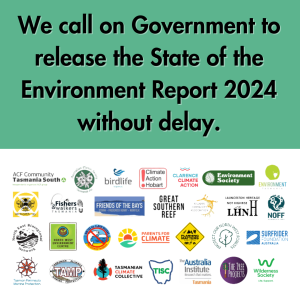
Joint Media Release: Decade-late State of the Environment Report should be immediately released
Today, 28 organisations have signed an open letter to the Rockliff Government calling for the

Mercury Article: State of the Environment Report 10 Years Late
“More than 30 conservation groups have signed a joint statement imploring the Rockcliff govt to

PMAT Joint Media Release: Publish the State of the Environment Report 2024
Over 30 groups from across Tasmania call for greater accountability in Government environmental decision-making.
Support Us
Receive News & Updates from PMAT
Stay informed on what’s happening locally and statewide within Tasmania, and join our community in advocating to protect Tasmania’s future.