Tasmanian State Coastal Policy

Summary

On 27 November 2025, we spoke at the Tasmanian Planning Commission State Coastal Policy hearings — and we’re deeply grateful to Nala Mansell for her powerful testimony.

Nala Mansell, Campaign Manager at the TAC, spoke clearly and powerfully about what proposed changes to the policy could mean for Aboriginal people — and for Country.

The Tasmanian Government is proposing to weaken the State Coastal Policy by introducing “tolerable risk,” replacing existing prohibitions on development in high-risk areas like actively mobile sand dunes with a test that makes development easier.

But for the Tasmanian Aboriginal community, dunes are not just coastal land. They are culturally significant places, including burial grounds.

lutruwita/Tasmania still has no Aboriginal Heritage Code to alert developers to sacred sites. That makes the coastal policy one of the last enforceable protections for Aboriginal burial grounds in dune systems.

What's being proposed

The Tasmanian Government is proposing major changes to Tasmania’s State Coastal Policy, which will have serious consequences for the future of lutruwita/Tasmania’s coastlines. 

The proposed changes will profoundly weaken the State Coastal Policy and the way Lutruwita/Tasmania’s coasts are managed and protected, such as making it easier to develop on sand dunes.

Tasmania’s coast is unique and largely unspoilt, thanks to the State Coastal Policy, which has protected it for almost 30 years. Tasmania’s coasts are one of the most ecologically and culturally important in Australia. It’s home to endangered species, dynamic landforms, cultural heritage, and natural defences against the impacts of climate change such as rising seas and storms. 

PMAT opposes the proposed amendment to Tasmania’s State Coastal Policy and instead supports The Tasmanian 2024 State of the Environment Report recommendation for a full review of the State Coastal Policy.

What’s Being Proposed
The proposed changes would weaken protections and potentially allow development on “hazardous” land such as sand dunes.

For more information please see the public consultation documents on the Tasmanian Planning Commission’s website here.

Quick Recap: What's Happened To Date

Validation (State Coastal Policy) Bill 2024

16 July 2024 - For a short two-week public comment period the Tasmanian Government released draft legislation, to retrospectively validate planning permits which they dubiously asserted were issued in conflict with the State Coastal Policy 1996.

Submission Results

1 August 2024 - Submissions closed on the Validation (State Coastal Policy) Bill 2024. PMAT released a submission guide helping generate a total of 402 submissions with over 97% opposing.

Validation (State Coastal Policy) Bill 2024

7 August 2024 - The State Government tabled the final legislation just three business days after the public submission period ended.

Validation (State Coastal Policy) Bill 2024

October 2024 - Despite overwhelming opposition, the Bill passed the Tasmanian Parliament. The Government also confirmed the Bill would validate the approval for the pilitika/Robbins Island wind farm that was being challenged in the Supreme Court at the time.

Review of the State Coastal Policy –Development of Actively Mobile Landforms Position Paper 2024

9 September 2024 - Separately to the Validation Bill the State Government released the Review of the State Coastal Policy –Development of Actively Mobile Landforms Position Paper for public comment.

Submission Results

21 October 2024 - Comment on the Position Paper closed. PMAT released a submission guide helping generate a total of 135 submissions.

State Coastal Policy draft amendment 01-2025

In response to the Position Paper, the Tasmanian Planning Commission released the State Coastal Policy draft amendment 01-2025 for public comment between 30 June and 25 August 2025.

Submission Results

A total of 203 representations was received on the draft amendment 01-2025 with 94% opposing the proposed draft amendment.

Public Hearings

27 Nov 2025 - PMAT alongside Nala Mansell, campaign Manager at the Tasmanian Aboriginal Centre spoke at the Tasmanian Planning Commission Public Hearings.

Please read PMAT’s background report: Proposed changes to the Tasmanian State Coastal Policy 1996 and the proposed Robbins Island wind farm. 

Key reasons why PMAT, the Tasmanian Conservation Trust and the Australian Coastal Society (Tasmanian Branch), encouraged the Tasmanian Parliament to oppose the Validation (State Coastal Policy) Bill 2024:

The need for the Validation Bill has not been established
  • Government has not released its advice
  • Existence of coastal infrastructure not confirmed
  • Government’s claims about lack of definitions and maps not substantiated
  1. The Supreme Court should be allowed to do their job
  2. Retrospective suspension of State Coastal Policy undermines the rule of law
  3. Impacts of the pilitika/Robbins Island wharf will not be assessed
  4. Public submissions raised serious concerns about the Validation Bill that were ignored
  5. Unintended consequences of the Validation Bill
  6. No need to rush changes
  7. Fast-tracking amending the Tasmanian State Coastal Policy to create a new assessment process for developments on actively mobile landforms

See more information for each reason in the Background Report below.

Please read PMAT’s Media Releases below:

Joint Media Release: Proposed changes to Tasmania’s Coastal Policy touches community nerve

Joint Media Release: State Government must scrap its proposed legislation to weaken the Tasmanian Coastal Policy

Joint Media Release: State Government must not legislate to kill ongoing court case over Robbins Island wind farm

Read the Media Release below: Tasmanian community overwhelmingly rejects proposed retrospective changes to State Coastal Policy – for more information and submission results. 

On 16 July 2024, for a short two-week public comment period the Tasmanian Government released draft legislation for the Draft Validation (State Coastal Policy) Bill 2024, to retrospectively validate planning permits which they dubiously asserted were issued in conflict with the State Coastal Policy 1996

Submissions closed on 01 August 2024 for the Validation (State Coastal Policy) Bill 2024. PMAT released a submission guide helping to generate a total of 402 submissions with over 97% opposing.

PMAT also released a community submission guide that can be viewed below.

The Environmental Defenders Office Submission in response to the Draft Validation (State Coastal Policy) Bill 2024. 

Submission to the Validation (State Coastal Policy) Bill 2024 by Ms Anja Hilkemeijer, Professor Jan McDonald, Dr Emille Boulot and Ms Cleo Hansen-Lohrey.

The Tasmanian Government  released a State Coastal Policy Position Paper for public comment to fast-track changes to Tasmania’s State Coastal Policy that closed Monday 21 October 2024. Note this was a separate process to the Validation (State Coastal Policy) Bill 2024. 

See PMAT’s Submission on the Coastal Policy Paper below.

PMAT also released a community submission guide that can be viewed below.

In response to the Position Paper, the Tasmanian Planning Commission released the State Coastal Policy draft amendment 01-2025 for public comment between 30 June and 25 August 2025.

See PMAT’s Submission is below.

PMAT also released a community submission guide that can be viewed below.

A total of 203 representations was received with 94% opposing the proposed draft amendment – submissions available at https://www.planning.tas.gov.au/assessments-and-hearings/current-assessments-and-hearings/state-coastal-policy-draft-amendment-01-25

PMAT does not support the proposed amendment to the State Coastal Policy 1996 and recommends it be abandoned, for the following key reasons:
  1. The need for the amendment has not been established;
  2. The problem with the definition/interpretation of ‘actively mobile landforms’ has not been
    established;
  3. False alarm about the need to define ‘actively mobile landforms’; and
  4. The proposed amendment will threaten actively mobile landforms.
Land-use planning should be incorporating strategies to avoid, reduce or control risks. The proposed amendment does the opposite, as it will allow development in high-risk hazardous areas such as sand dunes/frontal dunes and erodible soft sediment coastlines.
 
Counter to good hazard management, this change will likely increase liability to local Councils, and thus ratepayers and have flow on implications for the insurance sector and its customers. 

It is likely it will become significantly harder to insure properties in high-risk hazardous areas like soft sediment coastlines, where insurance premiums will become more expensive or even unavailable potentially 
 
Instead PMAT supports The Tasmanian 2024 State of the Environment Report recommendation for a full review. See information for each reason in the submission below.

Related News & Media

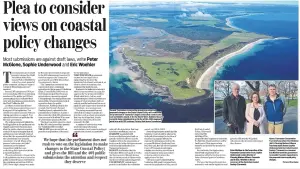
Image of Robbins Island/pilitika thanks to Rob Blakers

Support Us

Make a donation to Planning Matters Alliance Tasmania. By supporting us you are ensuring that we can continue to advocate and protect Tasmania's future through better planning.

Receive News & Updates from PMAT

Stay informed on what’s happening locally and statewide within Tasmania, and join our community in advocating to protect Tasmania’s future.

Scroll to Top