
Tasmanian Planning Scheme
Summary
PMAT's Key Concerns
What's at Risk
The Tasmanian Planning Scheme shapes our communities and our future, but puts at risk Tasmania’s greatest economic strengths: our natural and cultural heritage, our built environment, lifestyle and democracy.
Developed in a policy vacuum
The principal objection to the Tasmanian Planning Scheme is that it was developed in the absence of a comprehensive and transparent public conversation about a shared vision of the future via for example State Policies.
Fails to meet community expectations on a large number of issues
Reduces the community’s right to have a say and, in many instances, removes planning appeal rights, weakening democracy.
Greater Ministerial power in planning.
No provisions for social or affordable housing.
Favors the development sector over local communities.
Unregulated short stay visitor-accommodation reduces housing supply and increases rents. As of May 2024, inner city Hobart has the highest density of short stay accommodation of any city in Australia and Hobart is the equal least affordable city nationally.
No provision for Aboriginal Cultural Heritage.
Exemptions in how biodiversity is managed: exemptions in the Natural Assets Code (eg Agriculture, Commercial and Residential Zones) and mapping conventions mean many areas of native vegetation/habitat will not be assessed or protected, impacting biodiversity and leading to the loss of valuable urban trees.
No provision to embed sustainable transport, green building design and emissions reductions considerations into the planning process.
Sub-standard residential standards: standard setback, density and height provisions compromise urban character and increase neighbourhood disputes exacerbated by limited rights to challenge inappropriate developments. Smaller block sizes, higher buildings built closer to fences, and multi-unit developments in all residential areas are allowed. 100% impervious surface allowed (e.g. concrete and roof) increasing flood risk and heat island effects. Allows loss of local character with homogenised outcomes – eg the same residential standards that apply to big cities like Hobart also apply to small coastal towns like Bicheno, leading to a loss of local character.
Limited provisions to promote community health and well-being.
Limited protections for Heritage buildings and landscapes compromising Tasmania’s important cultural precincts and erosion of the heritage character of listed buildings.
Flawed development assessment in our National Parks and Reserves. Commercial tourism development and other inappropriate uses can be approved in most national parks and reserves without guarantee of public consultation, and with no rights to planning appeals. This means the public has no guarantee of public comment and no planning appeal rights over public land on almost 50% of the State.
Totally or partially exempts key land uses such as forestry, mine exploration, fish farming and dam construction.
Undermines Tasmania’s brand.
Absence of key planning codes: including no Stormwater Code, On-site Waste Water Code or Geoconservation Code.
Rigid planning rules make it difficult to protect local character
Local Councils and communities have limited flexibility to introduce different provisions to protect local character. The Tasmanian Planning Commission may allow local variation through the Local Provisions Schedule via Particular Purpose Zones (PPZs), Special Area Plans (SAPs) or Site-Specific Qualifications (SSQs), but only if satisfied that:
- the use or development is of significant social, economic or environmental benefit; or
- the site / area has particular environmental, economic, social or spatial qualities that require provisions unique to that area of land.
This is a narrow test. While there is support for standard provisions in relation to issues such as infrastructure, biodiversity and hazard management, local character and heritage protections demand greater flexibility.

Photo description: Front cover of the Tasmanian Planning Scheme. Photo Credit: State Government Planning Reform website.
PMAT's Key Recommendations
Amend the Land Use Planning and Approvals Act 1993
To ensure the process for developing and/or amending the Tasmanian Planning Scheme is transparent and independent. The Minister for Planning does not need to accept the advice of the Tasmanian Planning Commission when making or amending the Tasmanian Planning Scheme. Any decision that is contrary to the advice of the Tasmanian Planning Commission should require public consultation and parliamentary approval (the latter is the case for Projects of State Significance).
Re-balance the Tasmanian Planning Scheme to improve the public’s right of say
Re-balance the Tasmanian Planning Scheme to improve the public’s right of say. Too many uses and developments are characterised as permitted and therefore not subject to public comment or planning appeal rights.
Amend the Local Provisions Schedule to better maintain local character
Commit to reducing barriers and allowing greater flexibility for local councils/community to introduce provisions the council believes will best maintain local character and heritage protections.
Amend the Tasmanian Planning Scheme in key areas such as
Climate change/energy: commit to embedding sustainable transport, green building design and emissions reductions in the planning process.
Community health and well-being: commit to providing provisions to promote better health for all Tasmanians. This includes facilitation of walking and cycling opportunities, ensuring local access to recreation areas and addressing food security.
Housing: commit to providing provisions to encourage development of affordable and social housing.
Visitor accommodation: commit to amending all residential zones to give councils the power to better regulate visitor accommodation.
Aboriginal cultural heritage: commit to providing provision for impacts on Aboriginal Heritage to be considered in development assessment via an Aboriginal Heritage Code.
Residential standards: Commit to providing provisions which adequately protect neighborhood amenity and character, privacy, sunlight in backyards, homes and on solar panels with greater rights to planning appeals. Commit to providing residential standards that encourage home gardens – important for food security, connection to nature, places for children to play, mental health, well-being and beauty.
Development assessment in National Parks and Reserves: commercial tourism development can be approved in most national parks and reserves with no guarantee of public consultation or rights to planning appeal over public land on almost 50% of Tasmania. This is also due to the current absence of a statutory basis for the Reserve Activity Assessment (the Parks and Wildlife Service’s internal assessment process) and statutory definition of its relationship to the Land Use Planning and Approvals Act 1993. PMAT recommends making all Level 2 and 3 Reserve Activity Assessments a Discretionary use within the Tasmanian Planning Scheme.
Fix the Biodiversity/Natural Assets Code in line with the recommendations made by the PMAT commissioned August 2022 review of the Natural Assets Code by Dr Nikki den Exter. Dr den Exter completed her PhD thesis investigation into the role and relevance of land use planning in biodiversity conservation in Tasmania. Dr den Exter also works as an Environmental Planner with local government and has over 15 years’ experience in the fields of biodiversity conservation, natural resource management and land use planning. As both a practitioner and a researcher, Dr den Exter offers a unique perspective on the importance of land use planning in contributing to biodiversity conservation.
Commit to creating provisions with protections for Tasmania’s heritage places, important cultural precincts, and listed buildings.
Commit to creating key planning codes for example for Aboriginal Heritage, Stormwater, On-site Waste Water and Geodiversity.
Campaigns
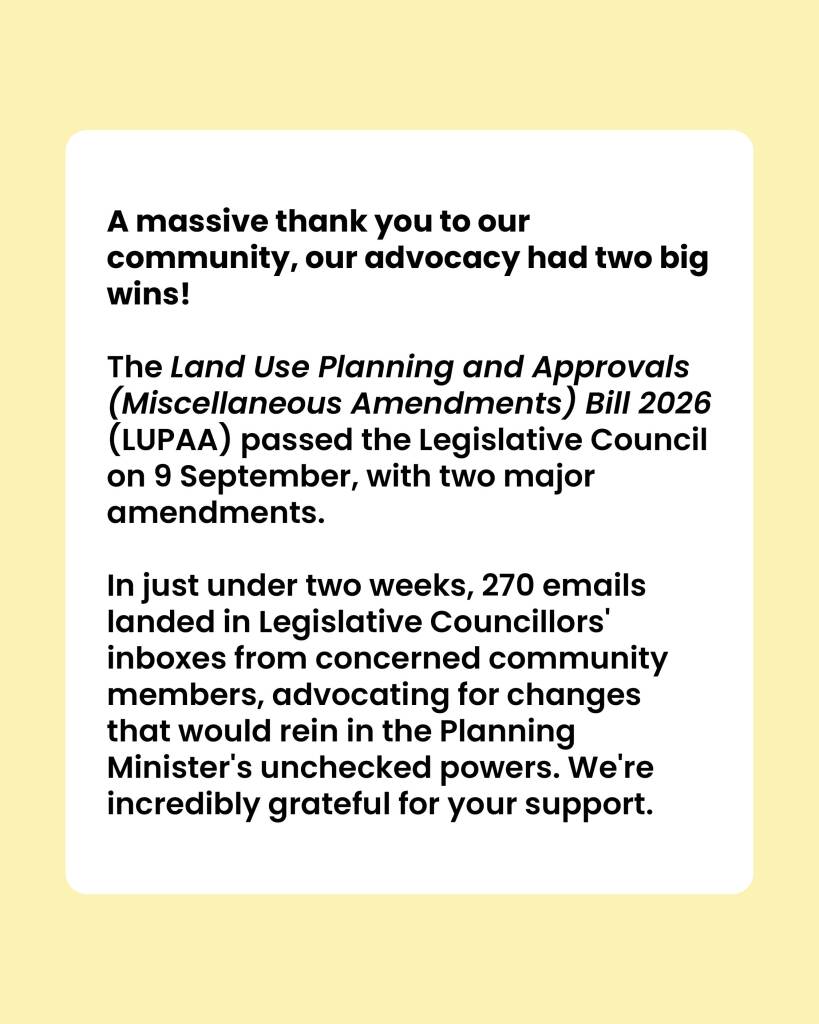
In 2026, the Planning Minister tried to give himself unchecked new powers to re-zone land and apply/remove the 16 planning Codes of the Tasmanian Planning Scheme. The Land Use Planning and Approvals (Miscellaneous Amendments) Bill 2026 (LUPAA) passed the Legislative Council on 9 September, with two major amendments. Here’s what happened, and what it means for planning in Lutruwita/Tasmania.
What we achieved
In just under two weeks, over 270 emails landed in Legislative Councillors’ inboxes from concerned community members like you, advocating for changes that would rein in the Planning Minister’s unchecked powers. We’re incredibly grateful for your support.
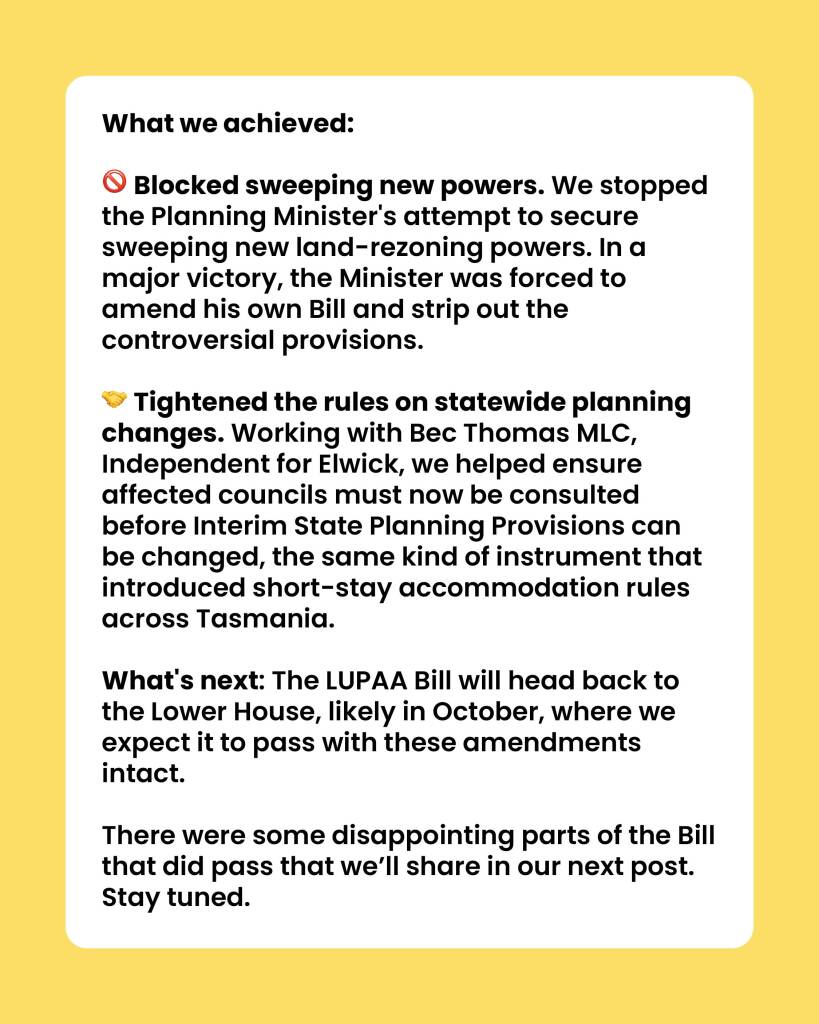
🚫 Blocked sweeping new powers. We stopped the Planning Minister’s attempt to secure sweeping new land-rezoning powers. In a major victory, the Minister was forced to amend his own Bill and strip out the controversial provisions.
🤝 Tightened the rules on statewide planning changes. Working with Bec Thomas MLC, Independent for Elwick, we helped ensure affected councils must now be consulted before Interim State Planning Provisions can be changed, the same kind of powerful planning instrument that introduced short-stay accommodation rules across Tasmania.
What disappointingly passed
Despite the two key amendments we secured, the Minister now has new powers over how planning decisions are made across Lutruwita/Tasmania.
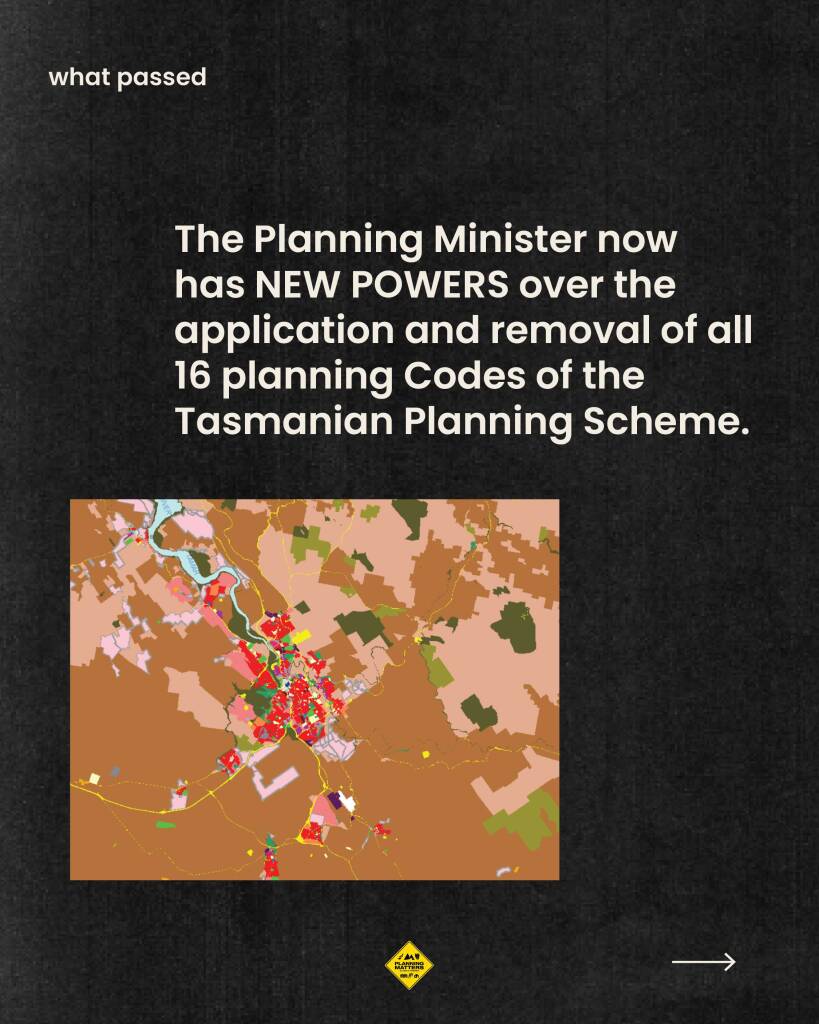
- The Planning Minister now has NEW POWERS over the application and removal of all 16 planning Codes of the Tasmanian Planning Scheme.
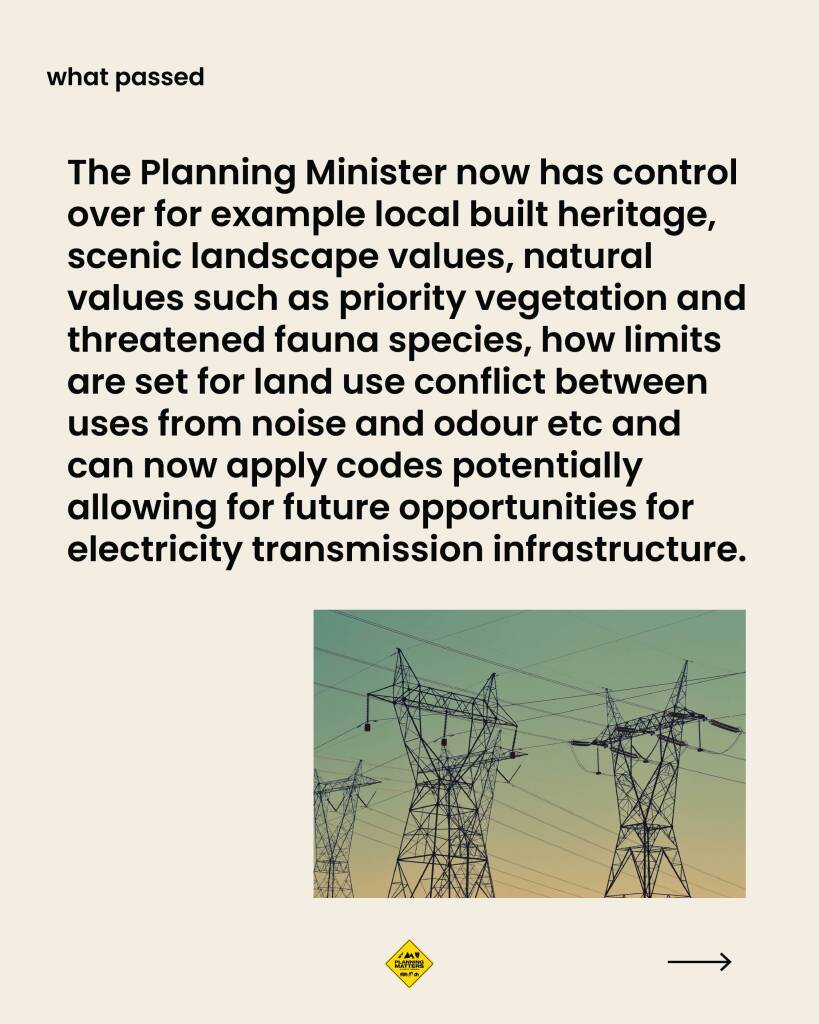
- The Planning Minister now has control over for example local built heritage, scenic landscape values, natural values such as priority vegetation and threatened fauna species, how limits are set for land use conflict between uses from noise and odour etc and can now apply codes potentially allowing for future opportunities for electricity transmission infrastructure.
- New laws passed to streamline data centre construction in Tasmania under Clause 10 of the Bill.
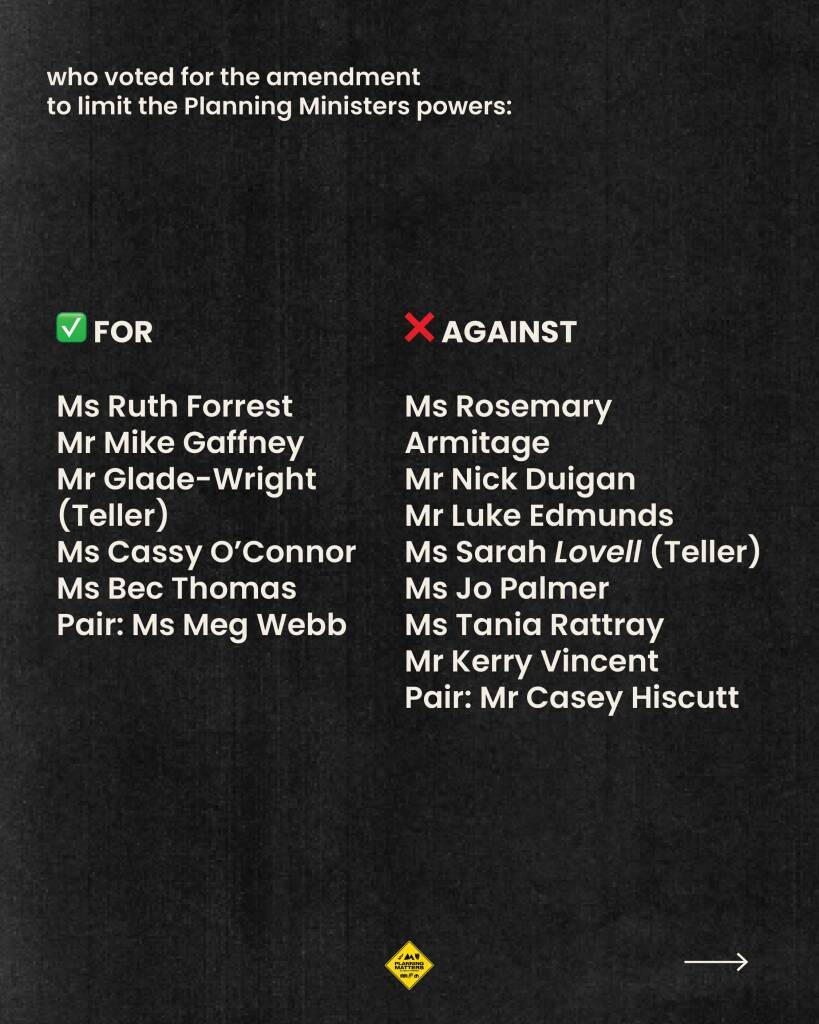
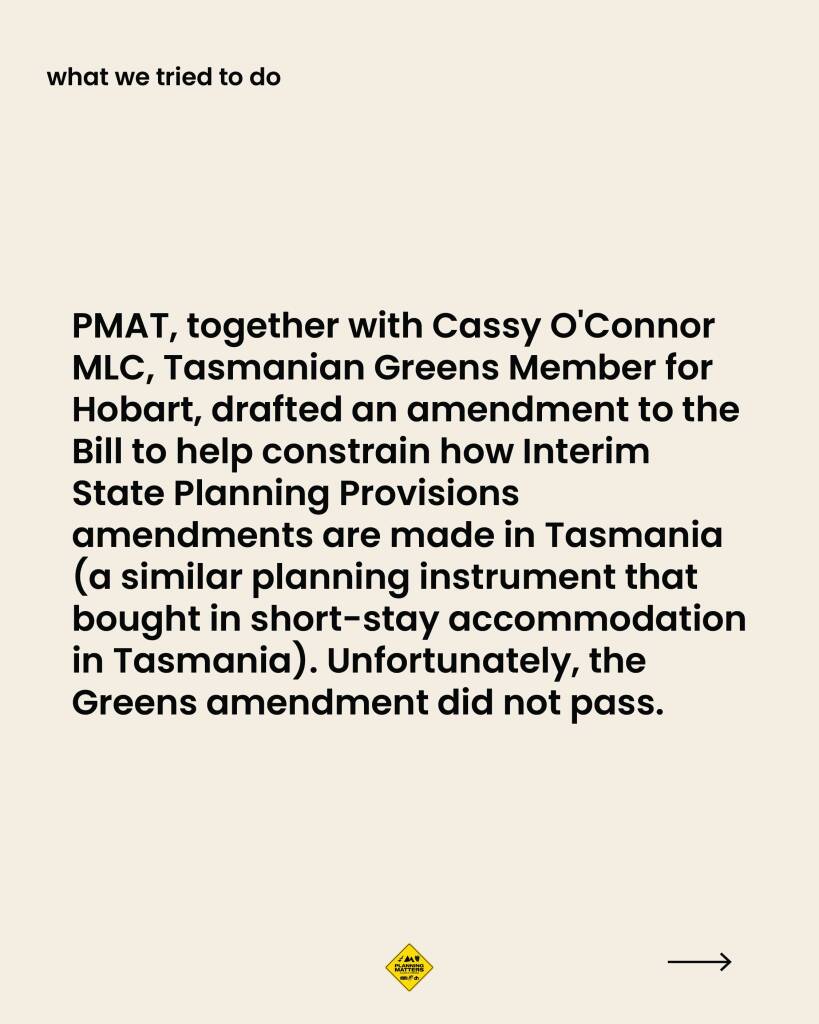
PMAT, together with Cassy O’Connor MLC, Tasmanian Greens Member for Hobart, put forward an amendment to try and limit the Minister’s powers over the 16 planning Codes. It was sadly defeated, 5 votes to 7.
How your Legislative Councillors voted:
For the amendment to limit powers:
Ruth Forrest, Mike Gaffney, Glade-Wright (Teller), Cassy O’Connor, Bec Thomas
Pair: Meg Webb
Against the amendment to limit powers:
Rosemary Armitage, Nick Duigan, Luke Edmunds, Sarah Lovell (Teller), Jo Palmer, Tania Rattray, Kerry Vincent
Pair: Casey Hiscutt
A second Greens amendment, drafted with Cassy O’Connor MLC, to constrain how Interim State Planning Provisions amendments are made in Tasmania, also sadly did not pass.
What’s next
The LUPAA Bill now heads back to the House of Assembly, likely in October, where we expect it to pass with the amendments we helped secure.
The two key amendments we helped secured couldn’t have happened without our community. Every email sent and post shared made a big difference. Thank you to the Legislative Councillors who supported our work. We hugely appreciate the time and huge effort you took to try and help achieve better outcomes for our planning system.
PMAT put out a media release on the outcome that you can read here.
View the Tasmanian Liberal Government’s Tasmanian Planning Scheme FACT SHEET below.





Submissions & Guides
2026 AUG: Land Use Planning and Approvals (Miscellaneous Amendments) Bill 2026
See PMAT’s guide was created to help the Tasmanian community email the Legislative Council on the Land Use Planning and Approvals (Miscellaneous Amendments) Bill 2026 before it went to vote on Wednesday, 09 September 2026.
What we achieved
In just under two weeks, over 270 emails landed in Legislative Councillors’ inboxes from concerned community members like you, advocating for changes that would rein in the Planning Minister’s unchecked powers. We’re incredibly grateful for your support.
🚫 Blocked sweeping new powers. We stopped the Planning Minister’s attempt to secure sweeping new land-rezoning powers. In a major victory, the Minister was forced to amend his own Bill and strip out the controversial provisions.
🤝 Tightened the rules on statewide planning changes. Working with Bec Thomas MLC, Independent for Elwick, we helped ensure affected councils must now be consulted before Interim State Planning Provisions can be changed, the same kind of powerful planning instrument that introduced short-stay accommodation rules across Tasmania.
2026 MAY: draft Land Use Planning and Approvals (Miscellaneous Amendments) Bill 2026
Please see below PMAT’s submission regarding the draft Land Use Planning and Approvals (Miscellaneous Amendments) Bill 2026.
Consultation was open from 30 March to 11 May 2026.
2022 AUG: State Planning Provisions
Please see below PMAT’s submission regarding the State Planning Provisions Review.
PMAT’s submission (here and submission 150) raised 22 key concerns with associated recommendations for improvement (see page 9 for key concerns). PMAT also engaged three planning experts to make specific recommendations to improve Tasmania’s residential standards, and how we best manage built heritage and biodiversity through the planning system. We also re-submitted the Heart Foundation 2016 submission to re-emphasise the critical link between planning and mental and physical health.
Review other submissions here.
2021 FEB: Policy & Projects – No Planning Approval Required
Please see below PMAT’s submission regarding in response to the January 2021 Department of Justice Options Paper.
2020 MAY: State Planning Provision Review 2016
Please see below PMAT’s submission guide created to help the Tasmanian community comment on the Tasmanian Planning Commission Review Guide – Background to Recommendations which closed on the 15 May 2020.
Background
The new Statewide Tasmanian Planning Scheme shapes Tasmania’s future but, it puts at risk our natural and cultural heritage, lifestyle and democracy.
The former head of the powerful and influential Property Council chaired the process that created our Statewide planning scheme. This is a fundamental reason why it is out of balance, favoring the development sector over local communities.
The Tasmanian Planning Scheme reduces the community’s right to have a say and, in many instances, removes planning appeal rights, weakening democracy. The one size fits all Tasmanian Planning Scheme makes it very difficult to protect local character and significantly fails to meet community expectations on a vast amount of issues. See ‘PMAT’s Key Concerns’ outlined in the section below.
PMAT's Logo Represents What We're Advocating For

An alliance of community groups came together to form PMAT in 2016, with shared concerns about the Tasmania Planning Scheme.
PMAT officially launched, with our logo, in 2017. PMAT’s logo is a road sign, symbolic of how planning should guide us on our way to a shared vision of the future (rather than having it decided for us). Our logo contains important symbols about what makes Tasmania special – our homes and community, our towns, backyards and skylines, our coastlines, sea environment and rural landscapes, our heritage buildings and cultural places, our plants and animals, and our wild and inspiring landscapes.
Tasmania’s planning system was once considered to be the national gold standard – but this has been eroded by continued ‘planning reform’.
PMAT is now responding to the largest ‘planning reform’ since the 1990s. We are now not only advocating to improve the Tasmania Planning Scheme but are advocating for the entire planning system. Planning is like an ecosystem, if one part of the ecosystem is unhealthy, the whole system is impacted.
PMAT is now advocating or engaging in processes to improve the:
- Tasmanian Planning Scheme (via for example the Review of the State Planning Provisions)
- State Policies
- Draft Tasmanian Planning Polices and the final Tasmanian Planning Policies
- Regional Land Use Strategies review – this is currently on hold
- Major Projects assessment
- Local Provisions Schedules
- Tasmania’s Population Strategy
- The Tasmanian Housing Strategy
- The Future of Local Government Review
- The proposed highly concerning Development Assessment Panels (DAPs) on private/urban and public/reserved land.
What exactly is ‘Planning’?
Ever wondered how our towns and communities come into existence and function smoothly? How is it possible for hundreds, thousands, and even millions of people to live, work, eat, and engage in various activities without turning to chaos?
The answer lies in the process of planning.
Planning should be a collaborative effort involving governments, business, and communities to shape and develop their communities. The realm of planning is vast and complex. It encompasses a wide range of areas, such as housing, how the community has a say, transportation, heritage preservation, environmental conservation, energy efficiency, and safeguarding against natural disasters like droughts, fires, and floods (to name just a few.)
How do we effectively manage and implement planning? The key lies in the utilisation of a planning scheme.
What exactly is a Planning Scheme?
Every inch of Tasmania is covered by an invisible layer called a ‘planning scheme.’ The planning scheme dictates how land can be used and developed, and includes how we, the community, can have a say.
Tasmania’s new statewide scheme, the Tasmanian Planning Scheme, is being rolled out across Tasmania and as at May 2024 is operational in 23 of Tasmania’s 29 Council areas.
The Tasmanian Planning Scheme consists of the State Planning Provisions and Local Provisions Schedules.
The State Planning Provisions consist of 23 generic planning zones (eg General Residential Zone, Rural Zone, Commercial Zone, Open Space Zone) and 16 codes (eg Natural Assets Code, Bushfire-Prone Areas Code, Flood-Prone Areas Hazard Code, Scenic Protection Code, Local Historic Heritage Code).
The Local Provisions Schedules indicate how the State Planning Provisions (zones and codes) apply in each local Council area. The Local Provisions Schedules contain zone maps and overlay maps or description of places where the codes apply. See the Draft Local Provisions Schedule Approval Process here.
The Local Provisions Schedules can also vary the State standard rules to help protect local character via Particular Purpose Zones (PPZs), Specific Area Plans (SAPs), and Site-Specific Qualifications (SSQs).
Click here to view your local Council’s approved Local Provisions Schedule, and learn how your property or places you care about are zoned with LISTmap links.
Related News & Media
State Planning Provisions Review
The Tasmanian Planning Scheme (i.e. the State Planning Provisions) must be reviewed every five years. The first State Planning Provisions Review started in 2022 and continues. 162 submissions were received. PMAT’s submission (here and submission 150) raised 22 key concerns with associated recommendations for improvement (see page 9 for key concerns). PMAT also engaged three planning experts to make specific recommendations to improve Tasmania’s residential standards, and how we best manage built heritage and biodiversity through the planning system. We also re-submitted the Heart Foundation 2016 submission to re-emphasise the critical link between planning and mental and physical health.
PIA – What is Planning
The Planning Institute of Australia has released an excellent 2 minute video explaining planning and just how important it is! Planning is about how we shape our communities.
PMAT opinion piece published in the Mercury August 22, 2022: “Let’s imagine a planning system which benefits all the community“
This Factsheet was created in around 2017 when the Tasmanian Liberal Governmment introduced the Statewide/Tasmanian Planning Scheme and the promises they made about planning in Tasmania.
What role will Councils have?
forms a strong partnership in ensuring the community has confidence in the Planning Scheme.


PMAT Media Release: Solicitor General’s Confusion Highlights Flawed Planning Change
The Solicitor General has cited changes to Tasmania’s planning laws as ‘complex and prescriptive’ in an analysis that makes a mockery of Government’s pledge to

Scope of The Tasmanian Planning Policies – Have Your Say on Tasmania’s Future
The Tasmanian Government is seeking your input on the Scoping Paper of the draft Tasmanian Planning Policies (TPPs). The TPPs will also guide the review

Defending Tasmanian’s Right to Have a Say
During the Tasmania 2021 state election PMAT urged voters to call on all political candidates to defend the right of every Tasmanian to have a
Support Us
Receive News & Updates from PMAT
Stay informed on what’s happening locally and statewide within Tasmania, and join our community in advocating to protect Tasmania’s future.